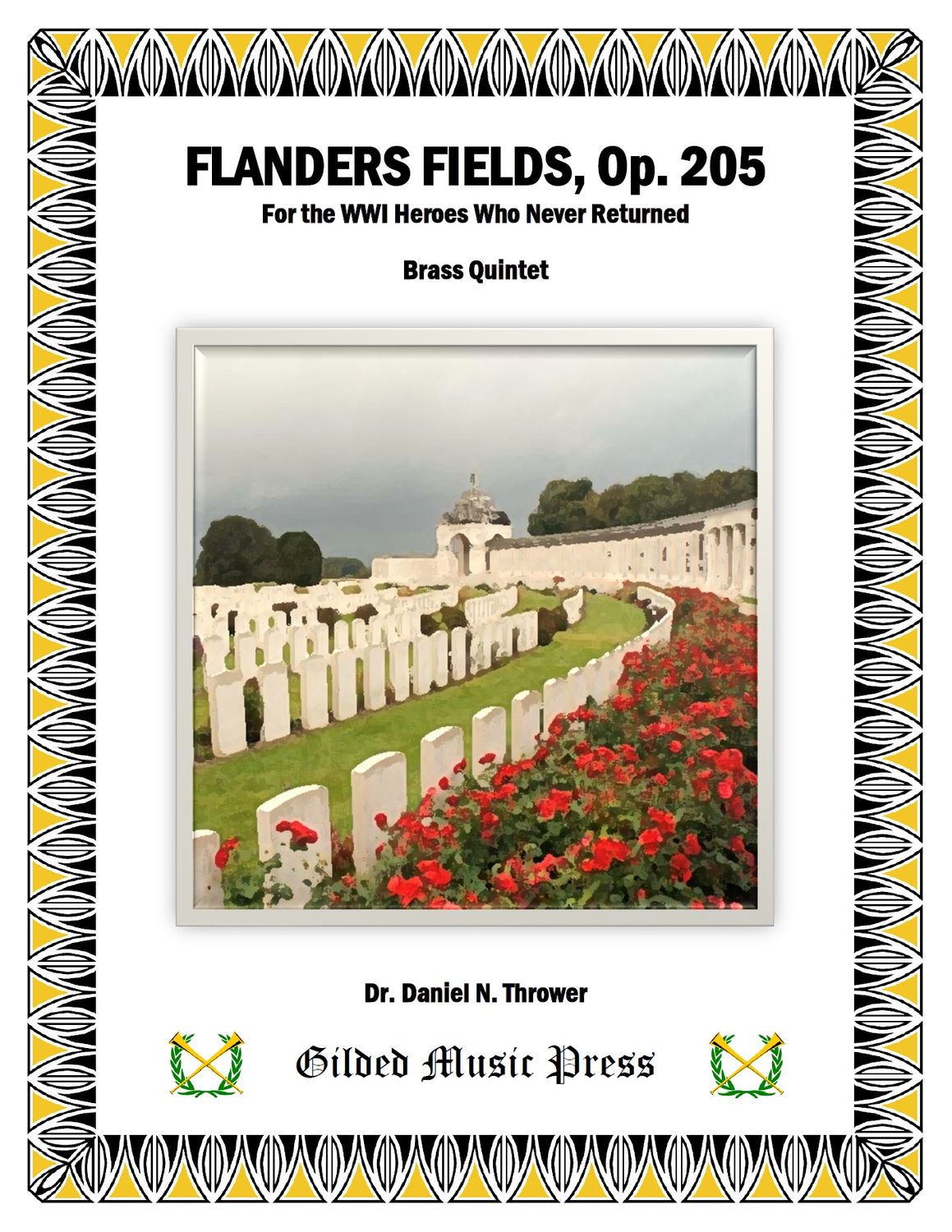
The fields of Flanders in Belgium are among the most hallowed landscapes in modern history. During the First World War, these quiet plains became the resting place of countless soldiers whose lives were extinguished in the mud and thunder of industrial warfare. Today the land is peaceful again—its skies wide, its farms quiet—but beneath that calm lies memory.
This composition reflects on that memory.
The work opens in the unusually dark key of A-flat minor, a tonal landscape rarely explored in brass music. Muted trumpets emerge softly, distant and veiled, as though heard across fog or across time. In this setting rises a solitary horn melody, part lament, part remembrance, re-exposed by a dense, organ-like echo in the lower brass. The music unfolds slowly, with the weight of reflection rather than the urgency of battle.
At one point the harmony briefly brightens, hinting toward A-flat major as if sunlight were breaking through clouds. Yet the brightness proves fleeting. The music soon turns toward F minor before returning to the original shadows and the opening motifs. Memory does not remain in the light for long; it returns to contemplation.
The work concludes not with resolution but with quiet unrest. Rather than returning to its tonal home, the music ends on a dominant open fifth—unresolved, waiting. The effect is intentional: remembrance does not end cleanly. The voices of the past linger, asking to be heard across generations.
After the final haunting sonority fades, the performers are given a final instruction: “Do not move.” The ensemble remains perfectly still, allowing the silence that follows to become part of the music itself. In that motionless moment, the unresolved harmony hangs in memory—hollow, suspended, and unfinished.
The title alludes to one of the most enduring poems of the First World War, written in 1915 by Canadian physician and soldier John McCrae after the death of a friend on the battlefield. His words became a universal expression of grief, remembrance, and responsibility.The unresolved ending of this piece reflects the enduring nature of that remembrance. History does not fully resolve; it continues forward in the lives of those who remember. The final stillness asks the listener to remain for a moment in that memory: quietly, and without motion.Gilded Music Press specializes in brass music and pedagogical materials composed and crafted by Dr. Daniel Thrower. His expertise and experience in the music world are now available in printed or PDF format for the music world's benefit.
For questions, specific requests, or to commission a new work from Dr. Thrower, please contact us via email or phone, below.
"You and your compositions deserve first rate ensembles, they’re that good! It’s an honor to know you and, from time to time, celebrate your wonderful accomplishments."

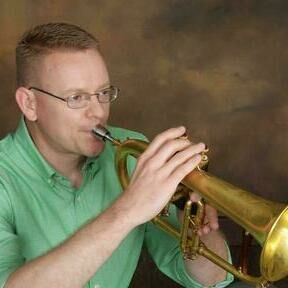
Dr. Daniel N. Thrower
Owner
"Gilded Music Press" was created specifically to make Dr. Daniel Thrower's high-quality music available. Dr. Thrower has been composing music and writing educational supplements for decades. He describes his music as a "personal musical journal". From his work with military ensembles to faculty and students of all ages, his music and teaching materials are created to edify audiences, professional colleagues, students, and himself. Through "Gilded Music Press" the global music community benefits from his excellent research, experience, and creative output. Many have enjoyed and benefited from his work throughout the world, and you will too once you discover his phenomenal products!